

Resilience and Grief
Climate Change, Funerals, Transitions, and Permanent Change

My sister and I are planning a funeral right now.
We’re the only children. Our father passed away in the late 2010s, and our mother recently after an illness that accelerated over about six months. Both of us are in our 50s and at this point in our lives have experienced the loss of many friends, relatives, and acquaintances. Yet some kinds of death can differ in the depth and intensity of the grief they provoke.
Why talk about grief in the context of resilience? In my experience, grief and resilience can be intertwined, feeding from the same root. But grief can also strangle and restrain our resilience, blurring the boundaries between feeling and action.
I began writing about climate grief in the late 2000s — I suspect my essay on the long-lost climatechangewater.org site on the subject was one of the very first to explore the topic, but I and others in AGWA have returned to the issue on occasion, and climate grief has expanded more broadly within the culture. There are even therapists and social workers who specialize in the topic, given how widespread the emotion is in some cultures.
Beginning as a grad student in the mid-2000s, I also saw how climate grief could cripple effective action. The tension between ecosystem and species conservation and the adaptation and resilience movement is a very clear example: many who have worked to “preserve” and “protect” ecosystems feel that their efforts have become a “fight” against the relentless, accelerating, and intractable enemy of climate change. They grieve a time in their lives when climate impacts seemed more theoretical, when before our choices seemed very clear and obvious with no complex downside: we can simply replant a clear-cut forest with the trees that were there before, we can regulate polluters within fixed boundaries, and we can battle invasive species wherever we may find them. Climate change muddles all of those issues. I’ve argued elsewhere that the overarching narrative of conservation is to stop “loss” and restore past conditions, but climate change is — in our current understanding of the science — not really a reversible condition. Conservation can be reconciled with adaptation and resilience and be renewed for this century, but in practice … the synthesis doesn’t occur very often.
From a traditional perspective, climate change accelerates loss to an extreme. And grief is a natural response to that loss: grief in the knowledge that our work in the past may not have been very effective, grief for the places and processes, institutions, and ecosystems and perhaps even communities and individuals who have been or will be lost, and grief (sometimes) for that more optimistic, less-aware self and sense of agency and action. A grief for a prelapsarian world.
The state of grief holding back the conservation movement and conservation science is starkly clear to me as a biologist, but I’ve also seen it in fields ranging from law and governance to engineering, planning, and finance. We badly want to keep things the same, minimize harm, or reverse the flow of change. Climate impacts are an existential threat to how we understand ourselves and the world.
And I’ve felt echoes in my own grief with my mother’s loss. It’s not just that my mother is no longer here and a vibrant part of my life. I can no longer hug her. I sat by her bed for weeks and days as she prepared to die. And her death has made me see the world in a different way.
I’m the elder generation now, one of those people I looked on as a child and teen as having lived literally in a different century, with a kind of unknowable experience I can only guess at. (My son has difficulty imagining that I was born in the 1960s, before moon landings much less mobile phones. But as a child, I knew people born in the 1880s and 1890s before powered flight and telephones.) A baton has been handed to the next runner, and I can see another runner coming up behind me now. My own death seems that much closer. A transition has happened, one of both permanence and immanence.
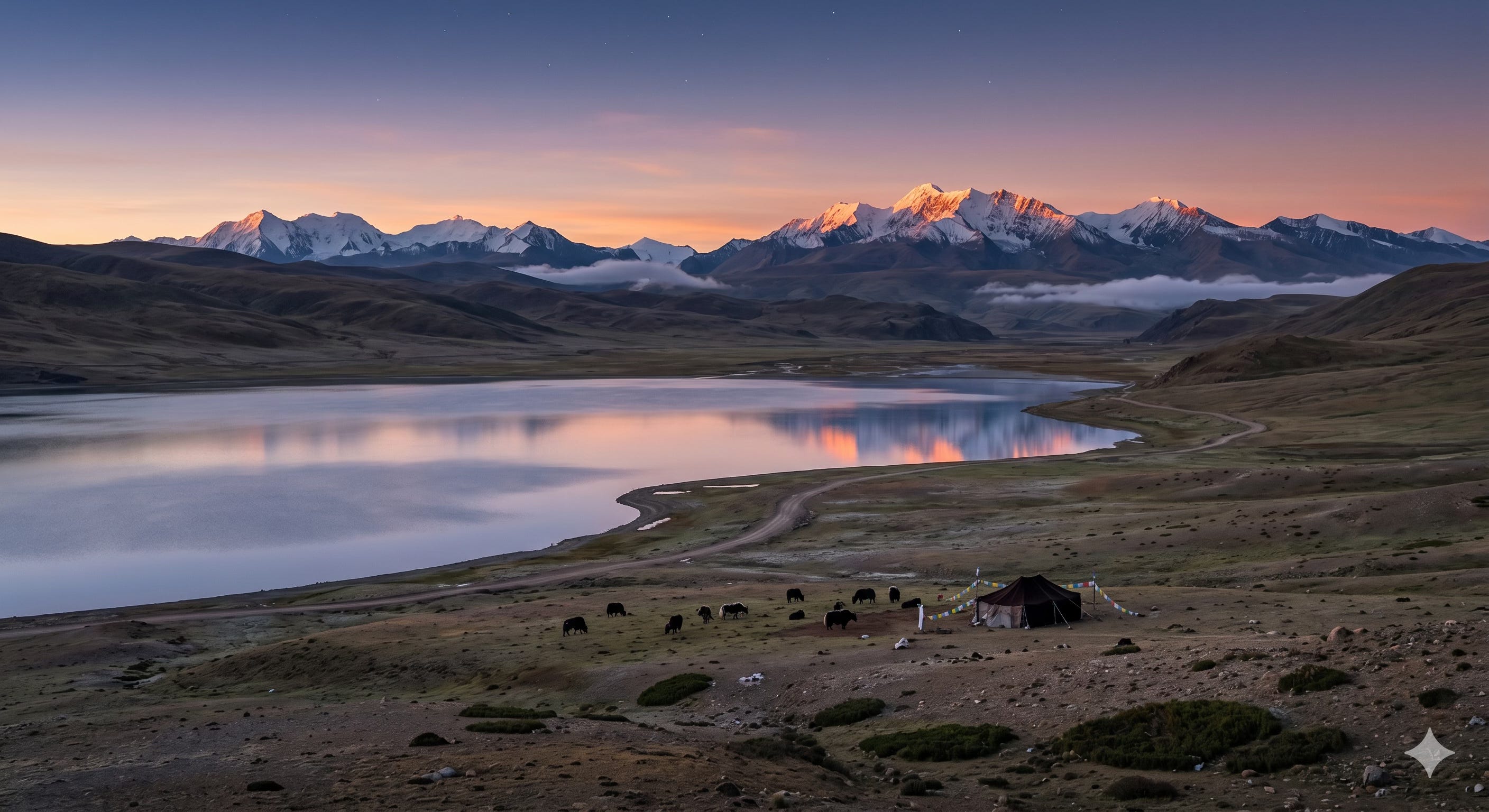
I experienced my own grief in conservation shortly after I began calling myself a conservation biologist, following a trip to the Tibetan plateau. That was the first time that I had seen a whole landscape that seemed to be falling into fragments and pieces, taking with it a culture that had been on that landscape for millennia. In a sense, there was little to save or reconstruct. The prime mover on this landscape wasn’t policy or regulations or even bulldozers. It was just climate change.
For several years, I struggled hard with what I had seen — and with my grief for the work I felt I had just started. I stopped calling myself a conservation biologist. I also came to see that my narrative was wrong: my work was not about stopping loss. It was about preparation and readiness. The landscape was not just being lost — communities and ecosystems were reorganizing, and we had urgent choices to make about how they could be reshaped and guided in more beneficial and less toxic ways. We had a useful role to play, and the communities of the plateau needed us. My previous narrative had trapped me within a cycle of grief and inaction. My new narrative was about helping cultures and economies and landscapes to transform and go through the big adjustments.
My grief did not really go away, but that grief ebbed to be partially displaced by a new motivation and understanding. I had to say goodbye and godspeed to a self that was no longer useful. My grief went from being an obstacle to a superpower as I understood resilience to be a renewed purpose.
I still felt quite young in my profession then. You certainly don’t have to be old to experience loss. And many young professionals in the world of resilience bear the signs of a grief stemming from a lack of clarity and certainty about their place in a landscape becoming seemingly denatured, the social rules askew.
Our mother’s funeral is still about a month away. As you may have noticed, writing has been difficult. Slowly, my sister and I been readying ourselves: what to say to her, to each other, to her friends, and to our family. How to make the funeral a celebration of her life and a marker in our transition: saying goodbye to both her and our world with her at a time when we are actively learning to live in a world without her. We look forward.
The reorientation is difficult. I am hoping to lead some songs she loved, though I still have difficulty making it through all of the verses. I am also old enough to know that the grief will not end even if it changes form and expression, goes quiet for time, and gradually transfers into a deeper love for those who will take my baton after me. I honor my grief, even as I pray that it leads me to be a better, more useful person.
John Matthews
Corvallis, Oregon, USA
So heartfelt and a wonderful way to look at grief and transition. Prayers for our world and our family.
My wish for you in light of your prayer: may your grief lead you to be a person with even more sensitivity to what is real and vital and possible. A hug from PDX