

Keynote Video: "Unbalancing" Conservation — Why Ecosystems & Economies Need Freshwater Resilience
Delivered 4 December 2025

Paul Ehrlich — probably the most famous ecologist of the past century — passed away a few days ago. He had a strong message that he delivered from the 1960s into the 1980s about reducing the human footprint on the planet. I met Paul a few times, and I certainly admire the significance and depth of his impact. In his time, he was a rock star in the public domain. No one really matches his stature in the environmental movement today. Most of us don’t even know how much of his worldview we have absorbed. He argued persuasively and passionately about maintaining the integrity of ecosystems and reducing the population impact of our economies and communities.
In many ways I grew up in his world. But we evolve with experience and insight over time, and I have also come to think that the issues of development and economic and ecological management are quite different than how he saw them.
Somewhat amusingly, he wrote a special essay when he joined the Royal Society, talking about the dire state of the planet and our damaging role in its destruction. Out of the hundreds of references and citations he included, a paper I led was also included — his very last citation, in fact. And one that he bracketed by saying, Not everyone has a negative view of the future.
I imagine he meant it as an insult, but the reference seemed hilarious to me. You can read that paper here if you’re interested: The Shifting Boundaries of Sustainability Science: Are We Doomed Yet?
I think he must have really hated the title. It still makes me giggle a bit.
He proudly called himself a conservation biologist and scientist, and he was also a noted field biologist with birds and butterflies. I had a very similar type of education as Paul, and indeed, we share an intellectual and advisor lineage. As biologists like to track those things, I am something like a cousin or a nephew in our academic relationship.
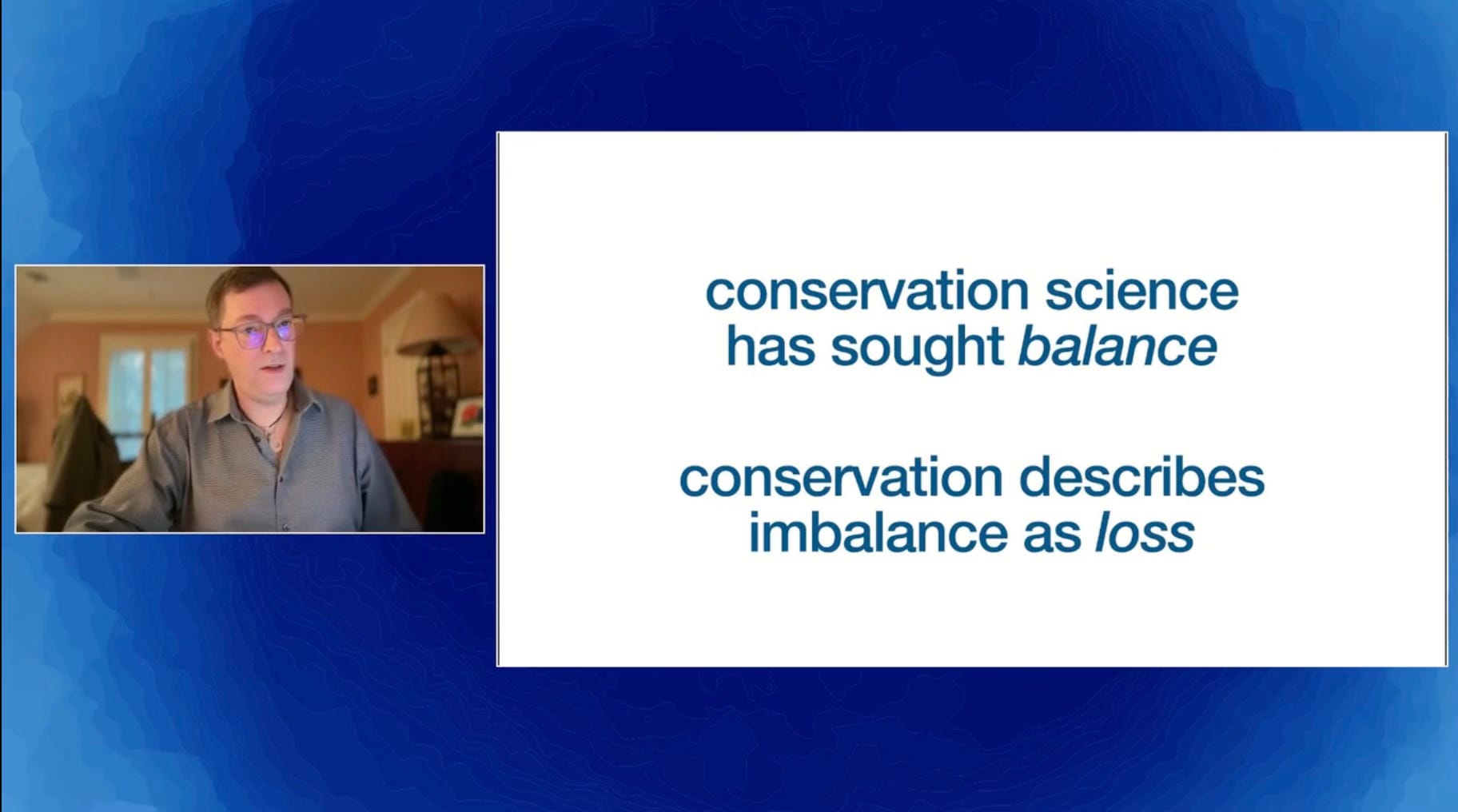
However, I no longer call myself a conservation biologist, however. I am a resilience scientist. Whereas his key argument could at least in part be reduced to “we need to get back into balance with ecosystems,” I’ve come to feel that “balancing” is a false target and could even hurt many of the things we care most about in our communities and the ecosystems around us.
I’d like to think that climate change presents us with a deep insight: we need to be “unbalanced" in how we interact with our environment in order to sustain ourselves and the natural world. I’d argue this is both an indigenous wisdom insight, and one that was actually quite close to the hearts and minds of some of the great biological and geological scientists of the 19th and 20th centuries. But not that many recently, who have often turned inward in a sense of tragedy, loss, and impossibly lost balance. We have choices about the future, to guide and select that future, but we also have constraints. Going backwards is no longer a choice.
This leads me to a strange irony: last August, I was invited by WWF’s Conservation Science Program to give the keynote for the 2025 Lovejoy Conservation Science Symposium.
You can link to the Lovejoy site here. Vimeo won’t allow me to post the video link directly here, but if you scroll down to Welcome and Fireside Chat, I am in the first link. My talk begins right about 5:08 and runs for around 20 minutes.
To me, conservation is largely an approach about returning to an impossibly receding past and not finding the emerging and potentially better futures we could be headed towards — what I think of as resilience and transformation.
Ultimately, I think this is a message about hope — and how we can improve ecosystems by helping them help us. Resilience is not about loss. It’s about choices within constraints. Not giving up, but giving back, especially to our descendants. I hope that message comes through and you will also become “unbalanced.”
Please comment! Don’t leave me hanging!
John Matthews
Corvallis, Oregon, USA