

Is deep resilience breaking through? Evidence from Los Angeles
Dethroning Efficiency and Conservation in Climate Adaptation

I started working on water and climate adaptation issues a frighteningly long time ago in 2007, and perhaps the most consistent point I have heard about how we should obviously respond/prepare for climate change is through reducing water consumption or — as a more operational sounding cousin — by increasing efficiency.
These are comforting statements and sound great on a panel with 90-second interventions or somewhere into your third martini, but not ones that actually make a lot of sense. They belittle the seriousness of the problem, assume that water scarcity is the biggest concern, and assume that an untested hypothesis will fix everything.
Why are reducing consumption / increasing efficiency weak statements? Let me count the ways! A few arguments:
Rarely is water scarcity the only climate impact on the water system in a particular place and system. Often other impacts — such as extreme precipitation events — are happening at the same time. Focusing only on one impact without examining how that might make you more vulnerable to others is a classic example of narrowly non-system thinking. Amman, Jordan, for instance, does generally have a water scarcity problem. They also have a new flooding issue, with rain bombs that a system optimized for water scarcity will be utterly unable to cope with. (Copenhagen and Amsterdam have precisely the opposite problem.)
Efficiency is a false god, and when the term raises its head, you should be asking a lot more questions: water use efficiency? economic efficiency? What kind of efficiency? efficiency for what? For most people, an efficient system is meeting a need with little waste. I would argue that efficiency is often the opposite of resilience — a highly efficient system assumes really just one future. And is probably very brittle and prone to catastrophic failure in the face of violations of (often unspoken) assumptions. And a theme you will likely hear more of in this space is that increased water use efficiency often means that users have simply reduced the costs of consuming water — and will now use a lot more. A typical pattern in manufacturing and agriculture. Described very well by the nineteenth century economic term Jevon’s Paradox: make things cheaper/easier to use, consumption increases.
Enter Los Angeles and the Metropolitan Water District.
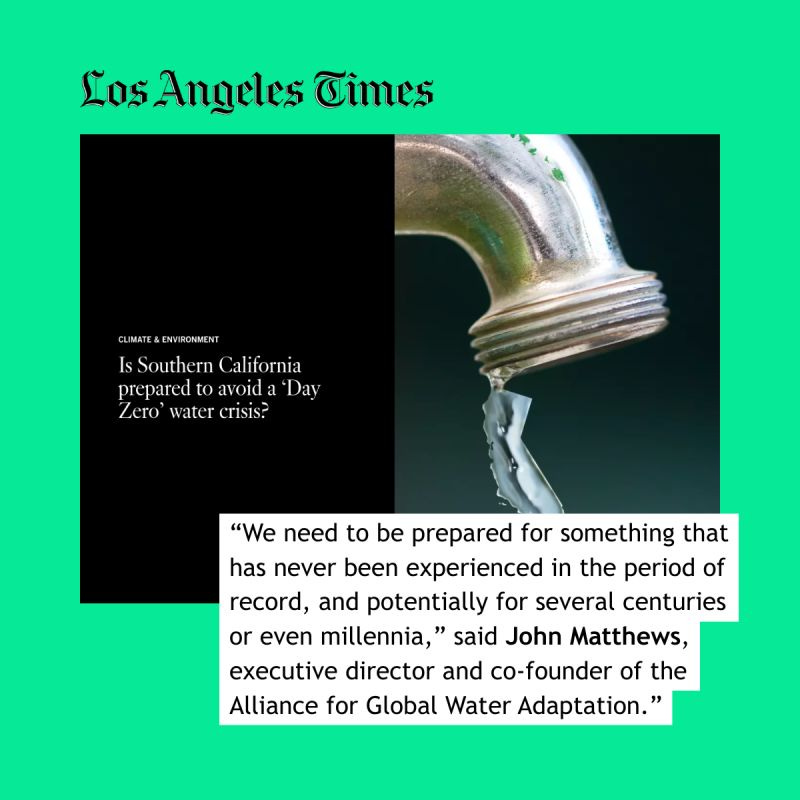
Crack water journalist Ian James with the Los Angeles Times reached out to me in June about a new climate adaptation for the region. He sent a link to the overview document as a basis for our interview, and we ended up speaking for at least an hour. We talked about the approach LA was taking. If a Cape Town style Day Zero event could occur in southern California (absolutely!). And who might be other good people for him to engage with — for instance, the former utility lead for Cape Town actually now lives in the US and works for the World Bank and could provide a very direct set of comments on parallels. Mike Webster occupies an interesting space in the final article. And you can read about both of us and some other great people in Ian’s piece, which came out last Sunday.
Often you can can infer a lot by the terms people use — or don’t use. In this report, I’d argue the authors were hiding a little bit, but they had some intriguing trigger words for a non-civilian like myself — especially around the challenges of managing for a complex and uncertain landscape that is not represented well by climate models. Which is a problem if (a) you are designing for an economy that would desiccate in the sun without abundant water, and (b) using long-lived infrastructure and management systems that are hard to adjust and evolve over time once they are up and running. The report is using general language and non-insider terms, which is good and necessary. But you can also tell what they were reading.
Enter deep uncertainty: the central challenge of how you manage a system when you can’t distinguish between completely different, alternate futures. Deep uncertainty is all over the problem statement for Los Angeles.
My personal view is that the answer to deep uncertainty is deep resilience: you prepare decisively for the things you know will happen but also build in flexibility and agility to shift course as you learn more. And you layer on other tools, such as redundancy and backup systems and pathways.
That’s exactly what Los Angeles is doing in response. Not least, I was struck by the extent of the system they are considering — effectively reaching to near the Canadian border! And how they are layering in solutions and pathways.
In many ways, this reminded me of a great conversation I had with Patricia Mulroy when she was still the lead for the Southern Nevada Water Authority and she spoke about how her little corner of Nevada (which includes Las Vegas) was both preparing new hardware but also acting as a facilitator and broker for “paper water” exchanges far up into Wyoming, northern California, and beyond. With the cleverness of a Renaissance Italian city-state, she kept her regional economy secure and stable — and leveraging its resilience at a much larger spatial scale.
That’s what LA is doing here, though the scope is even bigger given that the city is the second largest in the US.